
Can AI Really Screen IT Candidate Resumes?
Author:
Date: 02-02-2026
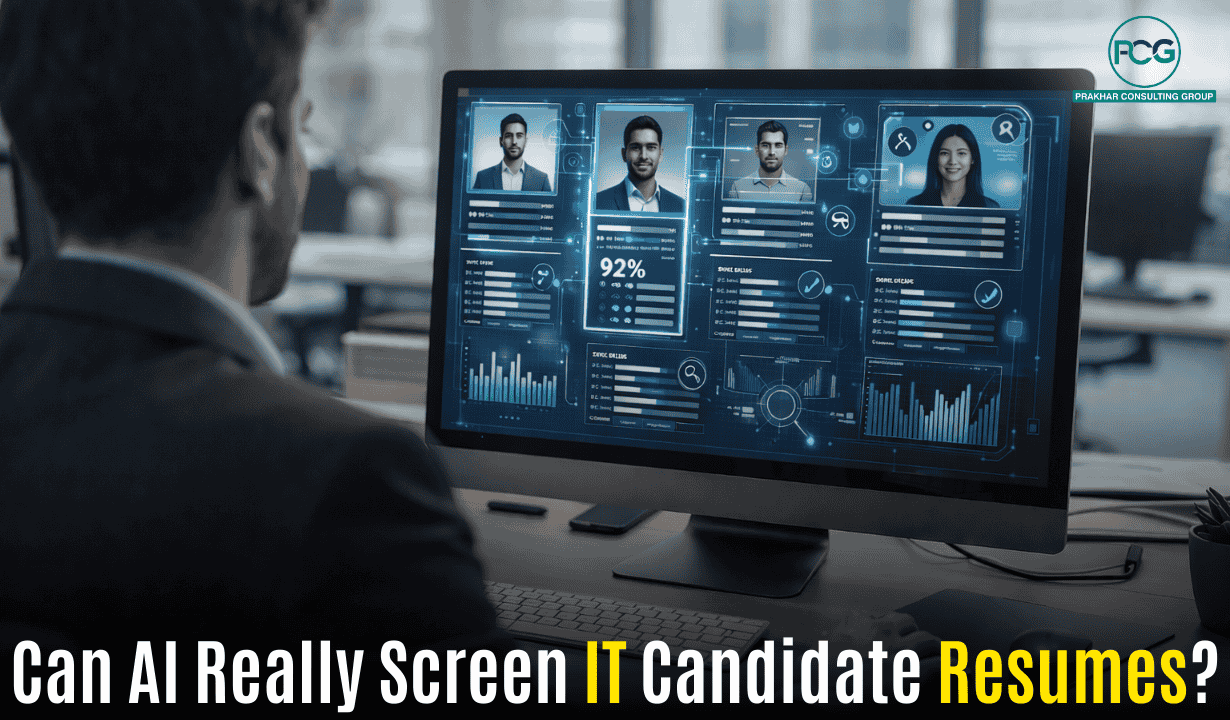
Recruiters today face an overwhelming volume of resumes. For every open IT role, hundreds of applications arrive within days. Most profiles look similar and inflated. Some are copied. Others hide real skill gaps.
In this pressure, manual screening becomes slow, inconsistent, and emotionally exhausting. Hiring managers expect speed. Candidates expect fairness. Recruiters are stuck in between.
In 2026, this challenge will be intensified with remote hiring, gig talent, and global competition. This blog is written for recruiters and for companies who should take IT Recruitment Services in India and want clarity on whether AI screening improves hiring quality or simply adds operational risk.
According to industry benchmarks, automated screening now touches over 65% of early-stage hiring workflows.
Skill Matching and Candidate Ranking
AI ranks skills accurately only when job data is structured. Ranking systems fail when job descriptions are copied without customization. Below are some latest facts to know:
- 61% of mismatches result from outdated JD templates (NASSCOM 2026).
- Skill graphs improved shortlisting by 32% (Gartner 2025).
Practical Guide
- Steps: Update job descriptions quarterly, map internal skills, train AI models.
- Checklist: Version control, competency definitions, validation cycles.
- Example: Cloud engineers were misranked due to generic “DevOps” labels.
- Warning: Inaccurate JDs distort AI decisions.
Bias Detection and Legal Compliance
AI reduces visible bias but may hide systemic discrimination. Most firms deploy AI without post-implementation bias audits.
- 41% of hiring algorithms showed gender bias (MIT 2024).
- Only 29% firms conduct audits (PwC 2025).
Practical Guide
- Steps: Run quarterly bias reviews, monitor rejection patterns, document overrides.
- Checklist: Gender ratio, college diversity, experience bands.
- Example: Tier-2 college candidates were filtered automatically.
- Warning: Legal exposure increases without transparency.
Impact on Recruiters: You remain legally accountable for automated decisions.
Resume Parsing and Data Extraction
AI parses resumes faster than humans but struggles with professional context. Many clients using Manpower Temporary Staffing Services depend on AI parsing for volume management, but accuracy drops with inconsistent resume formats. Check the below stats:
- 78% of ATS platforms use AI parsing (HRTech Survey 2025).
- Parsing errors affect 14% of resumes (TalentTech Report 2024).
Practical Guide
- Steps: Standardize resume templates, test parsing weekly, audit samples monthly.
- Checklist: PDF compatibility, section labels, skill taxonomy.
- Example: A Java developer profile was missed due to image-based formatting.
- Warning: Poor parsing creates invisible talent loss.
Impact on Recruiters: Faster processing but higher dependency on document quality.
Candidate Experience and Employer Brand
AI improves speed but may weaken candidate trust. Automated rejections without feedback harm employer branding.
- 54% candidates dislike AI-only screening (Indeed 2024).
- Response time improved by 47% with AI (LinkedIn 2026).
Practical Guide
- Steps: Personalize templates, offer feedback, enable escalation.
- Checklist: Rejection tone, response SLA, contact points.
- Example: Automated mails caused negative reviews.
- Warning: Brand damage is difficult to repair.
Impact on Recruiters: You become reputation managers, not just screeners.
How to Decide in 2026?
- Choose AI when: Application volume exceeds 300 resumes per role.
- Avoid AI when: Roles demand deep domain evaluation.
- Cost Range: ₹2-12 lakh annually for mid-size firms.
- Time Required: 8-16 weeks for deployment.
- Risk Factors: Bias, vendor lock-in, compliance gaps, poor integration.
AI screening will evolve toward behavioral analytics, real-time skill validation, and project-based assessments. Recruitment Services in India will increasingly integrate AI governance frameworks. Risks around data privacy will grow.
Opportunities will emerge for recruiters who master ethical automation. Prakhar Consulting Group has delivered recruitment transformations across:
- IT services, fintech
- Manufacturing
- Startups
Our team has implemented, audited, and optimized hiring systems for over 120 organizations. We combine compliance, analytics, and operational expertise to build sustainable talent pipelines.
Conclusion
AI can screen resumes faster than any human team. It can organize, rank, and filter at scale. But it cannot evaluate ambition, adaptability, or integrity. In 2026, successful recruiters use AI as a partner, not a replacement. The future belongs to those who strike a balance between intelligence and empathy. Hiring remains a human responsibility. If you are looking for the top IT hiring services in India, get in touch with Prakhar Consulting Group.
FAQs
Q1. Can AI accurately screen IT candidate resumes in 2026?
Yes, AI can screen resumes accurately in 2026 when supported by clean data, updated roles, and human validation.
Q2. Is AI resume screening reliable for specialized IT roles?
AI is reliable for standard roles but still requires human judgment for specialized technical positions.
Q3. Does AI resume screening create hiring bias?
AI can create bias if trained on biased data, which is why regular audits are essential.
Q4. Should recruiters rely completely on AI for shortlisting?
Recruiters should use AI as a support system, not as a replacement for professional judgment.
Q5. What is the first step to implementing AI resume screening?
The first step is standardizing job descriptions and cleaning historical hiring data.