
What Is the Future of Recruitment in India After AI Adoption?
Author:
Date: 27-04-2026
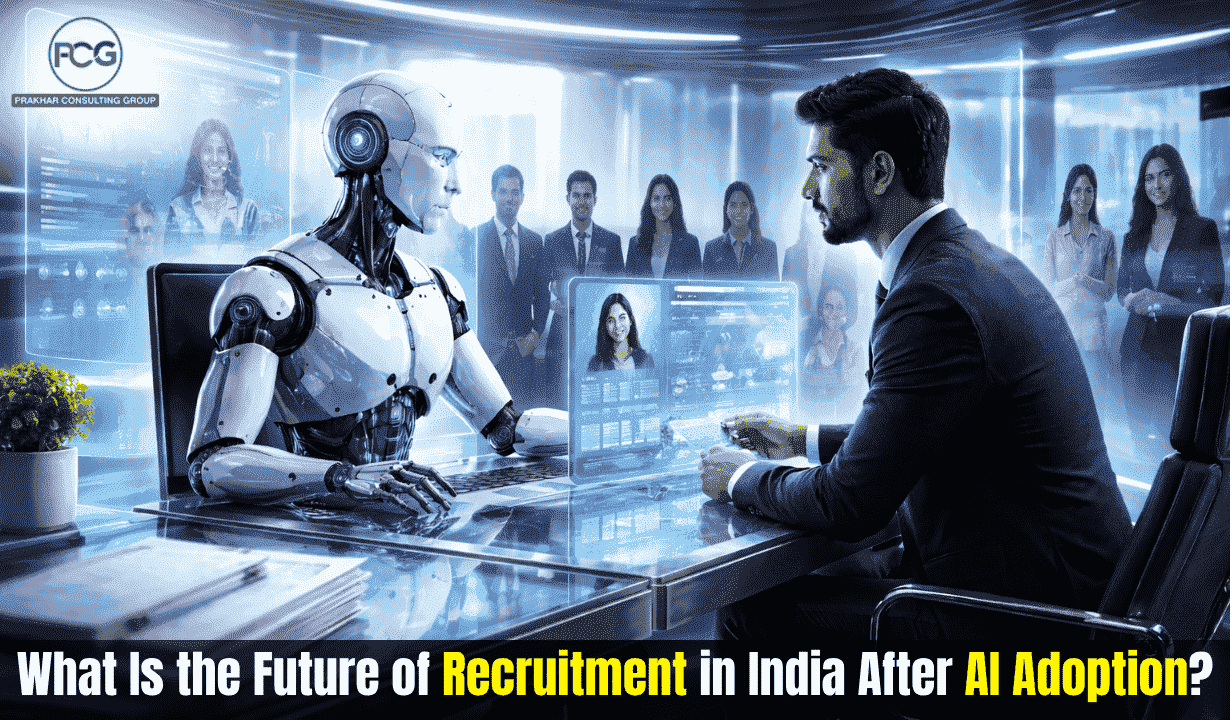
AI is making recruitment in India faster, skill-based, and data-driven, but success depends on strong hiring systems and compliance.
Many Indian companies still struggle with hiring. They take too long to close roles, hire the wrong candidates, and face high early attrition. Now, HR Consulting and Staffing Services in India are moving towards AI-based hiring systems.
AI is shifting recruitment from guesswork to structured, data-driven decision making. AI-led hiring in India is moving from reactive hiring to predictive workforce planning.
How AI Is Redefining Recruitment Systems in 2026?
AI is turning recruitment into a predictive and structured decision system. Organizations like NASSCOM and LinkedIn Talent Solutions show that AI is changing how companies hire, screen, and evaluate candidates.
A 2026 trend analysis shows that companies using AI reduce hiring time by 30% to 45% while improving shortlist quality.
Hiring System Framework
- AI resume screening reduces manual effort by up to 60%.
- Skill-matching algorithms improve job fit.
- Automated interviews reduce screening time.
- Data dashboards track hiring performance.
Here’s what the numbers reveal: In 2026, companies using structured AI hiring report 25% to 32% better candidate-job alignment.
According to HR advisors at NASSCOM, “AI improves speed, but hiring quality depends on process design and validation.”
Most companies overlook that AI cannot fix a broken hiring funnel. It only scales what already exists.
Why Workforce Planning Matters More Than Hiring?
Workforce planning is now more important than recruitment execution. The Ministry of Labour & Employment and NSDC are pushing structured workforce strategies across sectors.
According to 2026 reports, companies with quarterly workforce plans reduce early attrition by 18% to 25%.
Workforce Planning Model
- Role demand forecasting is linked to business growth.
- Skill-gap mapping using industry benchmarks.
- Hiring timelines aligned with project cycles.
- Budget allocation per role and function.
In fact, mid-sized firms in India still experience early attrition rates of 28% to 35% due to poor planning.
A workforce advisor at NSDC explains, “Hiring without planning increases cost, delays, and attrition risk.”
How Compliance and Payroll Are Evolving This Year?
AI is improving payroll accuracy but increasing compliance complexity. Regulators such as EPFO and ESIC are digitizing their compliance systems across India.
This has increased the need for a reliable Payroll Processing Company in India. Prakhar Consulting Group (PCG) helps businesses manage payroll, statutory filings, and workforce compliance across multiple states.
Compliance Control Checklist
- Accurate PF and ESIC filings
- Timely salary processing
- Correct employee classification
- Multi-location compliance tracking
According to 2026 reports, compliance errors increase operational costs by 8% to 12% annually.
A compliance consultant at EPFO says, “Automation reduces errors, but compliance still needs human supervision.”
How Staffing Models Are Changing in 2026?
Companies are moving towards flexible and hybrid staffing models. Organizations like Tata Group and Infosys are using a mix of permanent, contract, and project-based hiring.
The FMCG’s Permanent Staffing Process is also evolving. Prakhar Consulting Group (PCG) supports FMCG companies in building structured hiring systems that balance stability with flexibility.
Modern Staffing Structure
- Permanent roles for core operations.
- Contract roles for flexibility.
- Project hiring for niche skills.
- Gig hiring for short-term demand.
According to 2026 reports, flexible staffing adoption has increased by 30% to 40% across Indian industries.
An expert at SHRM India states, “Hybrid workforce models improve speed but require strong governance and tracking systems.”
Conclusion
The future of recruitment in India is not just about AI tools. It is about building structured, compliant, and scalable hiring systems. Companies that combine AI with workforce planning, compliance, and expert consulting will lead in hiring efficiency. For founders and HR leaders, hiring is now a business growth function. Prakhar Consulting Group continues to help organizations build future-ready recruitment systems with strong advisory support.
FAQs
1. What is the biggest change in recruitment after AI adoption?
Recruitment is becoming data-driven and predictive instead of manual.
2. How does AI reduce hiring time?
AI automates screening, shortlisting, and initial interviews.
3. Is AI replacing recruiters?
No, it supports recruiters but does not replace decision-making.
4. Why is compliance important in recruitment?
It prevents legal risks and ensures smooth operations.
5. Which industries benefit most from AI hiring?
IT, FMCG, manufacturing, and startups benefit the most.